Ome vs. Omelette: Key Differences Explained for Culinary Art
Ome vs Omelette

Ome vs. Omelette: Key Differences Explained for Culinary Art

Master the subtle yet significant distinctions between these classic egg preparations to elevate your cooking skills.

Uncover the Secrets

Key Takeaways

  • ✓ An omelette typically involves folding cooked eggs over a filling.
  • ✓ 'Ome' often refers to Japanese 'Omurice' or 'Omusoba', where eggs encase a main dish.
  • ✓ French omelettes are known for their smooth, pale exterior and moist, tender interior.
  • ✓ Japanese omelettes (Tamagoyaki) are often rolled in layers, resulting in a distinct texture.
  • ✓ The cooking technique and desired texture are primary differentiators.

How It Works

1
Understand the Core Concept

An omelette is a dish of beaten eggs cooked in a pan and folded, often around a filling. 'Ome' typically implies a dish where the egg component acts as a wrapper for another primary ingredient, as seen in Omurice.

2
Master the French Omelette Technique

Learn the swift, gentle swirling and folding method that yields a creamy, delicate interior and a smooth, unbroken exterior. This technique prioritizes a soft, almost custardy texture.

3
Explore Japanese 'Ome' Variations

Delve into dishes like Omurice, where a thin, perfectly cooked egg sheet is draped over fried rice. Alternatively, explore Tamagoyaki, a rolled, layered sweet or savory egg preparation with a distinct density and texture.

4
Practice and Personalize

Repeated practice is key to mastering the nuances of each style. Experiment with different fillings and seasonings to personalize your egg creations and develop your own signature touch.

The Classic Omelette: A Study in French Culinary Finesse
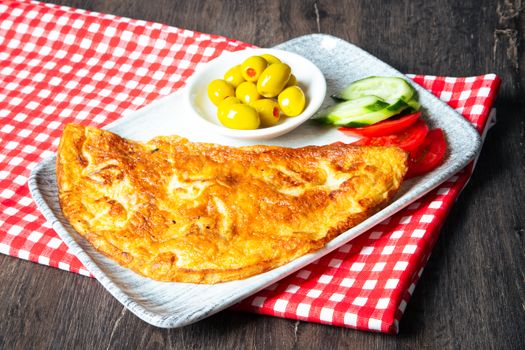
Golden omelette served with green olives, cucumbers, and tomatoes on a checkered cloth. Photo: Emine Gizem / Pexels
When we speak of 'omelette' in its most traditional sense, especially in the Western culinary world, our minds often drift to the exquisite French omelette. This isn't just a simple scrambled egg; it's an art form, a testament to precision, speed, and subtle heat management. A true French omelette is characterized by its pale, almost uncolored exterior, often described as a delicate golden yellow, completely free of browning. Its interior, however, is where the magic truly lies: a moist, custardy, and incredibly tender consistency that almost melts in the mouth. The technique demands eggs, often just two or three, whisked just enough to combine yolk and white, but not over-aerated. The pan, ideally non-stick and sized appropriately for the number of eggs, must be hot but not smoking, with a pat of butter sizzling gently. The eggs are poured in, and with a swift, continuous motion, the cook stirs the eggs from the center outwards, tilting the pan to allow uncooked egg to flow underneath. This process is rapid, typically lasting no more than 30-60 seconds. Just as the eggs are mostly set but still very moist on top, any desired filling (often just herbs, cheese, or fine-chopped ham) is added along the center. The omelette is then skillfully rolled or folded into a neat, cigar-like shape or a crescent, often using a rubber spatula or the pan's edge, before being gently slid onto a plate. The goal is a uniform, elegant presentation, a silky texture, and a rich, buttery flavor. Mastery of the French omelette is considered a benchmark for many aspiring chefs, as it demonstrates control over fundamental cooking principles. It's a dish that celebrates simplicity and technique, proving that extraordinary results can come from humble ingredients with the right touch. This foundational understanding is crucial before delving into other egg preparations, including the 'Ome' variations, as it sets a high bar for egg cookery. The pursuit of the perfect French omelette is a journey of culinary refinement, emphasizing technique over complexity. For those interested in perfecting this skill, numerous online culinary arts guides offer detailed tutorials.

Exploring 'Ome': Japanese Culinary Interpretations

The term 'Ome' is less a standalone dish and more commonly a prefix or suffix in Japanese cuisine, signaling a dish where egg plays a distinctive role, often as an encompassing layer. The most famous example is 'Omurice' (Omu-rice), a beloved comfort food in Japan. Here, 'Omu' is a truncation of 'omelette,' but the resulting dish is distinct from its French cousin. Omurice features fried rice, often seasoned with ketchup or demi-glace, wrapped entirely within a thin, perfectly cooked sheet of egg. The egg is typically cooked very gently to maintain its soft, delicate texture, forming a golden, pliable blanket over the seasoned rice. There are two primary styles of Omurice egg preparation: one involves cooking a thin omelette and carefully folding it over the rice, creating a smooth, unblemished surface. The other, more dramatic and Instagram-famous method, involves cooking the egg until just set on the bottom while the top remains very runny. This 'fuwa-torro' (fluffy-torro) style is then quickly transferred onto the rice, and a skillful cut down the middle causes the still-runny egg to spill open and envelop the rice in a creamy, unctuous blanket. This technique requires immense precision and timing to achieve the desired effect. Another prominent 'Ome' dish, though not explicitly called 'Ome,' is 'Tamagoyaki,' a rolled Japanese omelette. While sharing the 'omelette' root, Tamagoyaki is fundamentally different in its construction and texture. It involves cooking multiple thin layers of sweetened or savory egg mixture in a rectangular pan (makiyakinabe), rolling each layer over the last to create a dense, multi-layered block. The resulting texture is firm yet moist, with distinct layers, and can be served hot or cold, often as part of a bento box or as a sushi topping. Unlike the French omelette's singular, uniform interior, Tamagoyaki celebrates its layered complexity. These Japanese 'Ome' dishes highlight how the egg, while a central ingredient, serves a different function – often as a structural element or a textural contrast to a larger component. The emphasis shifts from the egg's internal creaminess to its ability to wrap, bind, or layer, showcasing a different facet of egg cookery as a diverse culinary art.

Our partners at monkey-app.net offer related services.

Distinguishing Features: Technique, Texture, and Presentation

The fundamental differences between a classic omelette (specifically French) and the various 'Ome' preparations from Japan boil down to three crucial aspects: technique, resulting texture, and overall presentation. **Technique:** The French omelette demands a rapid, high-heat, and continuous stirring motion in the pan to achieve a soft, uncurdled scramble that then sets into a smooth, pale exterior with a moist, creamy interior. The folding is swift and precise, often with minimal filling, ensuring the egg remains the star. In contrast, Omurice's egg component is typically cooked more gently and thinly, designed to be pliable enough to wrap or drape over rice. The 'fuwa-torro' style, while appearing rapid, involves delicate handling to ensure the interior remains liquid. Tamagoyaki, on the other hand, is a slow, methodical process of building layers, often over low to medium heat, pressing each layer as it cooks to create a uniform, dense block. The continuous rolling and layering is a stark contrast to the single-fold approach of a French omelette. **Texture:** This is perhaps the most significant differentiator. A perfectly executed French omelette boasts an incredibly tender, almost custardy, moist interior, encased by a very thin, unbroken, and unbrowned exterior. It's designed to be delicate and melt-in-your-mouth. Omurice's egg, while also soft, is generally thinner and more uniformly set, or, in the 'fuwa-torro' style, features a dramatic contrast between a set exterior and a runny, creamy interior that coats the rice. Tamagoyaki offers a completely different experience: a firm yet spongy, multi-layered texture, often with a slight sweetness or savoriness depending on its seasoning, and a distinct chewiness that comes from its layered construction. It's dense and holds its shape, unlike the delicate French omelette. **Presentation:** The French omelette is typically presented as a neat, elegant, self-contained package—a golden, often cigar-shaped or half-moon fold, sometimes garnished simply with fresh herbs. The egg is the primary visual focus, highlighting its smooth surface and perfect form. Omurice, conversely, presents the egg as a covering or a dramatic reveal over a mound of fried rice. The egg's role is to encase or dramatically unveil the main ingredient, often drizzled with sauce on top. Tamagoyaki is usually served sliced into rectangular pieces, showcasing its beautiful internal layers, often as part of a larger meal or bento. Each presentation reflects the dish's culinary purpose and aesthetic values. Understanding these distinctions allows one to appreciate the diverse culinary artistry within egg preparations, moving beyond simple definitions to a deeper appreciation of technique and cultural context. Exploring these differences can inspire new approaches to everyday cooking.

Mastering Egg Artistry: Tips for Perfect Omelettes and 'Ome' Dishes

Achieving perfection in any egg dish, whether a delicate French omelette or a complex Japanese 'Ome' creation, requires attention to detail and consistent practice. Here are some key tips to elevate your egg artistry: * **Quality Ingredients Matter:** Always start with fresh, high-quality eggs. Their flavor and texture are paramount. Using fresh butter for cooking, especially for French omelettes, also contributes significantly to the final taste. * **Pan Selection is Crucial:** For French omelettes, a non-stick pan (ideally 8-10 inches) with gently sloping sides is essential for easy rolling and smooth texture. For Tamagoyaki, a rectangular pan (makiyakinabe) is traditionally used, though a small round non-stick pan can work with careful technique. * **Heat Control is Key:** For French omelettes, medium-high heat is typically used to cook quickly without browning. For Omurice egg wraps, medium-low to medium heat ensures a pliable, uncolored sheet. Tamagoyaki benefits from consistent low-to-medium heat to build layers evenly. * **Don't Over-Whisk:** For French omelettes, whisk eggs just enough to combine yolks and whites, avoiding excessive aeration which can make the omelette tough. For Tamagoyaki, whisk well to ensure a uniform mixture for consistent layers. * **Season Appropriately:** Simple seasoning (salt and pepper) is often best for French omelettes, letting the egg's flavor shine. Tamagoyaki often includes dashi, soy sauce, mirin, and sugar for a distinct flavor profile. Omurice egg is usually unseasoned, relying on the rice below. * **Speed and Agility for French Omelettes:** The cooking process is very fast. Have your filling ready and warm if needed. Work quickly with a rubber spatula to stir and then fold. * **Patience for Japanese 'Ome':** Tamagoyaki requires patience to cook and roll each layer. Omurice's 'fuwa-torro' style demands precise timing to achieve the runny interior. * **Practice, Practice, Practice:** Egg cookery is highly tactile. The more you make these dishes, the more you'll understand the nuances of heat, timing, and technique. Don't be discouraged by initial imperfections; every attempt refines your skill. **Common Mistakes to Avoid:** * **Overcooking:** The most common mistake for French omelettes, leading to a dry, rubbery texture and browning. * **Too Much Filling:** For French omelettes, excessive filling makes folding difficult and can overwhelm the delicate egg flavor. * **Incorrect Pan Temperature:** A pan that's too cold will make the egg stick; too hot will brown it too quickly. * **Lack of Confidence:** Hesitation can lead to overcooked or poorly shaped results. Be decisive in your movements. By focusing on these tips and avoiding common pitfalls, you can transform simple eggs into exquisite culinary masterpieces, appreciating the distinct art behind each 'ome' and 'omelette' creation.

Comparison

FeatureFrench OmeletteJapanese Omurice EggJapanese Tamagoyaki
Primary TechniqueQuick stir & foldThin sheet, wrap/drapeLayered rolling
Desired TextureCreamy, moist interiorSoft, pliable (or runny interior)Firm, layered, spongy
Exterior AppearancePale, unbrowned, smoothGolden, thin, smoothGolden-brown (from layers)
Typical Filling/ContextSmall, delicate fillings (herbs, cheese)Envelops fried riceServed plain or with minor additions
Pan TypeSloping non-stick panFlat non-stick panRectangular makiyakinabe
Cooking Time (approx.)30-60 seconds1-2 minutes3-5 minutes
Culinary PhilosophySimplicity, elegance, egg as starEgg as wrapper for main dishLayered complexity, texture contrast

What Readers Say

"This article beautifully articulates the subtle yet profound differences between omelette and 'ome'. It's essential knowledge for anyone serious about culinary arts, truly demystifying these classic egg preparations."

Chef Antoine Dubois · Montreal, QC

"As someone who loves both French omelettes and Omurice, this explanation of 'Ome vs. Omelette' clarifies so much. The distinction in technique and purpose is perfectly highlighted."

Sakura Tanaka · Vancouver, BC

"Following the advice here, my French omelettes are now consistently smooth and creamy, and I've even attempted Tamagoyaki with surprisingly good results. The emphasis on technique paid off!"

Liam O'Connell · Toronto, ON

"A very informative read, though I wish there were more specific ingredient ratios for each dish. Still, the breakdown of textures and techniques was incredibly helpful for understanding 'Ome vs. Omelette'."

Isabelle Chen · Calgary, AB

"This article is a goldmine for home cooks looking to elevate their egg game. It clearly explains why an omelette isn't just an 'ome' and vice-versa, inspiring me to try new dishes."

Rajesh Kumar · Edmonton, AB

Frequently Asked Questions

What is the primary difference between an omelette and 'Ome'?

The primary difference lies in their culinary origin, technique, and function. An omelette (typically French) is a folded egg dish where the egg's creamy interior is the star. 'Ome' usually refers to Japanese dishes like Omurice or Tamagoyaki, where the egg acts as a wrapper or a layered component for another main ingredient, or has a distinct layered structure.

Is one healthier than the other?

Neither is inherently healthier than the other; it depends on the ingredients and preparation. A plain French omelette or Tamagoyaki can be very healthy. However, Omurice, with its fried rice and sauces, might be higher in calories and carbs. Fillings and cooking fats significantly impact the nutritional value.

How do I make a perfect fluffy French omelette?

To make a perfect fluffy French omelette, use fresh eggs, whisk them just enough, heat a non-stick pan to medium-high with butter, pour in eggs, stir rapidly from center to edges until mostly set but still moist, add minimal filling, and quickly roll or fold onto a plate. Speed and precise heat control are key.

What kind of pan should I use for Tamagoyaki?

Traditionally, a rectangular pan called a 'makiyakinabe' is used for Tamagoyaki to achieve its characteristic shape. However, a small, good quality non-stick round pan can also be used, though it might require more skill to shape the layers into a rectangle.

Can I use any filling for an omelette?

While you can use various fillings, for a traditional French omelette, it's best to use small amounts of pre-cooked or finely chopped ingredients like herbs, cheese, or ham, as too much filling can prevent proper folding and overpower the delicate egg flavor. Japanese 'Ome' dishes have specific pairings like fried rice for Omurice.

Who benefits most from understanding these distinctions?

Home cooks looking to expand their culinary repertoire, aspiring chefs, and anyone with a keen interest in global cuisine will benefit most. Understanding these differences enhances appreciation for specific techniques and cultural nuances in food preparation.

Are there any safety concerns with undercooked eggs in 'Ome' dishes?

When preparing 'fuwa-torro' style Omurice, where the egg's interior remains runny, there is a slightly higher risk of salmonella if eggs are not pasteurized or handled improperly. Always use very fresh, high-quality eggs from a reliable source and ensure proper refrigeration to minimize risks.

What's the future trend for egg dishes in modern cuisine?

The future of egg dishes likely involves further fusion, combining techniques from different cultures, and an increased focus on plant-based egg alternatives. There's also a growing trend towards showcasing eggs as a gourmet ingredient in fine dining, emphasizing sustainable sourcing and unique preparations.

Ready to master the art of egg cookery? Dive deeper into the specific techniques for both omelettes and 'Ome' dishes. Elevate your culinary skills and impress with perfectly crafted egg creations today.

Topics: Ome vs Omeletteegg dishesFrench omeletteJapanese omeletteculinary techniques
Leo List
Brampton weed
Adultwork