
Mistakes to avoid when using the word '妻': A Cultural Guide
Master the art of correctly using '妻' to demonstrate cultural sensitivity and linguistic precision in your creative works.
Unlock Nuance NowKey Takeaways
- ✓ '妻' (tsuma) is a respectful term for 'wife' in Japanese, but its usage is context-dependent.
- ✓ Using '妻' inappropriately can lead to misunderstandings or sound archaic in modern settings.
- ✓ The arts, particularly literature and theatre, often explore the subtle power dynamics embedded in such terms.
- ✓ Understanding the historical evolution of '妻' is crucial for accurate artistic representation.
How It Works
Begin by grasping the fundamental definition of '妻' as 'wife' or 'my wife'. Recognize its inherent respectfulness, particularly when referring to one's own spouse.
Examine the specific social, historical, and relational context in which '妻' is used. Consider who is speaking, to whom, and about whom, as these factors dictate appropriateness.
Familiarize yourself with other terms for 'wife' or 'spouse' in Japanese, such as '奥さん' (oku-san) or '家内' (kanai), and understand their distinct implications and politeness levels.
Integrate this nuanced understanding into your artistic creations, ensuring characters' dialogue and narration reflect accurate cultural and linguistic sensibilities, enhancing authenticity.
The Historical and Etymological Roots of '妻' in Japanese Culture
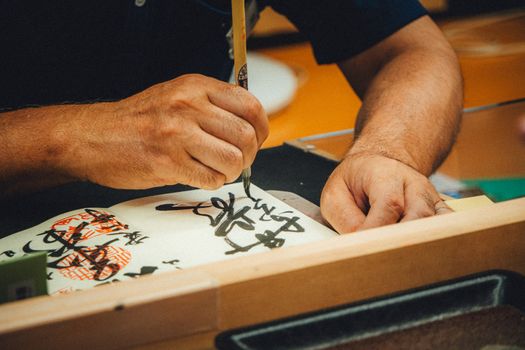 Photo: Liuuu _61 / Pexels
In classical Japanese literature, from the Heian period's 'Tale of Genji' to the Edo period's ukiyo-e narratives, '妻' frequently appeared, often imbued with a sense of formal respect and societal expectation. It wasn't merely a descriptor but a term that encapsulated a woman's role within the household and her husband's family. This formal and somewhat distant connotation is crucial. When translating or interpreting such works in an artistic context, understanding this historical baggage prevents anachronistic or culturally insensitive portrayals. For instance, a character in a historical drama referring to his '妻' would carry a different emotional and social weight than if he used a more intimate or casual term. Failing to recognize this can lead to characters sounding out of place, or worse, misrepresenting historical relationships.
Moreover, the evolution of '妻' is intertwined with the development of other terms for 'wife' in Japanese. Words like '奥さん' (oku-san), '家内' (kanai), and '嫁' (yome) emerged, each with their own politeness levels, social implications, and gendered nuances. '奥さん', for example, often carries a sense of polite distance and is typically used when referring to someone else's wife. '家内', meaning 'inside the house', is a humbler term used by a man to refer to his own wife, emphasizing her domestic role, though this is also becoming less common. The existence of these alternatives highlights that '妻' is not a catch-all term and choosing the correct word is an art in itself. An artist creating a piece set in modern Canada, perhaps featuring Japanese diaspora characters, must navigate these layers. Would a young, contemporary Japanese-Canadian man refer to his wife as '妻' in casual conversation? Likely not. This is where the first common mistake arises: assuming '妻' is universally applicable across all contexts and time periods. Understanding the cultural intricacies of Japanese honorifics can provide further clarity on such linguistic choices. The historical context dictates that '妻' often implies a certain formality and a traditional societal structure, making its casual use in contemporary settings a significant misstep.
Navigating Modern Usage: When '妻' Feels Outdated or Inappropriate
 Photo: Mikhail Nilov / Pexels
In casual, everyday conversation among younger generations, '妻' can often sound formal, somewhat archaic, or even a little stiff. It carries a gravitas that might feel out of place in informal settings. For instance, a young Canadian of Japanese heritage casually introducing his wife to friends would be far more likely to use '奥さん' (oku-san), or simply refer to her by name, rather than '妻'. Using '妻' in such a context might unintentionally create a sense of distance or formality that doesn't reflect the relationship. This is not to say '妻' is obsolete; rather, its domain has shifted. It is still commonly found in formal writing, legal documents, official announcements, or when a man wishes to express a particular level of respect or formality towards his wife, often in a public or semi-public setting.
Another critical aspect to consider is the perspective of the speaker. While a man might refer to his own wife as '妻' (particularly in more formal contexts), it is generally considered impolite to refer to someone else's wife as '妻'. For another person's wife, '奥さん' (oku-san) is the standard polite term. Misusing these terms can convey a lack of social grace or cultural understanding. An artist portraying a scene where a character addresses another's wife using '妻' would be creating a social faux pas within the narrative, potentially alienating the audience or misrepresenting character dynamics.
Furthermore, the shift towards more egalitarian language in modern Japanese society has led to terms like 'パートナー' (paatonaa - partner) gaining traction, especially among younger and more internationally-minded individuals, to refer to a spouse without specifying gender or traditional roles. This reflects a broader societal move away from strictly gendered language and roles. Artists exploring themes of marriage, identity, and gender in a contemporary Canadian context, particularly if their characters are navigating multicultural identities, should be acutely aware of these linguistic evolutions. To depict a modern Japanese-Canadian couple rigidly adhering to older linguistic conventions like frequent use of '妻' without narrative justification could inadvertently portray them as out of touch or perpetuate stereotypes. The key is intentionality: if '妻' is used, there should be a clear reason for it, whether to signify formality, tradition, a specific character's personality, or a deliberate stylistic choice, rather than simply as a default translation for 'wife'.
Our partners at pairsjp.com offer related services.
Artistic Representation: Avoiding Stereotypes and Enhancing Authenticity
Consider a theatrical play set in a Japanese-Canadian community in Vancouver. If a male character, perhaps a first-generation immigrant, consistently refers to his wife as '妻' in every interaction, it might accurately reflect his traditional upbringing. However, if his Canadian-born son, speaking to his friends, also uses '妻' to describe his spouse, it immediately rings false for many contemporary Japanese speakers. This kind of linguistic misstep can break immersion and undermine the credibility of the artistic piece. The audience, particularly those with a nuanced understanding of Japanese culture, will notice the dissonance.
To enhance authenticity, artists should treat the choice of 'wife'-referencing terms as a characterization tool. Does a character use '妻' because he is formal, traditional, or perhaps even emotionally distant? Does a character use '奥さん' to show respect when speaking about someone else's wife? Or does a character use a more intimate, informal term, or simply their wife's given name, reflecting a modern, egalitarian relationship? These choices reveal layers of personality, social standing, and relationship dynamics. For example, a character who deliberately chooses '妻' over a more modern term might be subtly asserting a traditional hierarchical view of marriage, which could be a critical plot point or character trait. Conversely, a character who avoids '妻' might be signaling a rejection of traditional gender roles.
Furthermore, when dealing with historical periods, the context of '妻' becomes even more vital. In classical Japanese art, literature, and performance, the term often carried connotations of status, duty, and lineage. Misinterpreting these connotations in a translation or adaptation can lead to a fundamental misunderstanding of the original work's themes. For Canadian artists adapting Japanese folk tales or classical poetry, a deep dive into the specific historical and social meanings of '妻' within those original contexts is indispensable. This careful attention to detail not only prevents cultural misrepresentation but also enriches the artistic output, providing a more profound and respectful engagement with the source material. Understanding the role of language in cultural storytelling is key to achieving this level of authenticity. Ultimately, the goal is to make informed linguistic choices that serve the narrative and character development, rather than relying on superficial translations.
Common Pitfalls and How to Correct Them When Using '妻'
The Evolution of '妻' in Japanese Literature and Arts
In the Heian period (794-1185), as exemplified by 'The Tale of Genji', '妻' (pronounced 'tsuma' or sometimes 'me') could be used to refer to a primary wife, often of noble birth, who held a significant position within the household and clan. However, the period also saw other terms for consorts or secondary wives, reflecting a complex marital system. The emotional weight attached to '妻' in these narratives often spoke to duty, lineage, and the intricacies of court politics, rather than purely romantic love. An artist adapting such a work would miss crucial subtext if they treated '妻' merely as a generic 'wife'.
Moving into the Edo period (1603-1868), with the rise of the samurai class and a more rigid patriarchal structure, '妻' became more firmly entrenched as the formal term for the legal wife, often contrasted with '妾' (mekake, concubine). Woodblock prints (ukiyo-e) and Kabuki theatre frequently depicted scenes involving '妻', highlighting her role in managing the household, raising children, and maintaining family honour. The term often carried an air of stoicism and endurance, reflecting the expectations placed upon women of the era. The portrayal of a '妻' in an Edo-period play, for instance, would be imbued with specific social cues and expectations that are vital for an actor to understand and convey.
The Meiji Restoration (1868) brought significant societal shifts, including Western influences, which gradually began to challenge traditional family structures. As Japan modernized, so too did its language. While '妻' retained its formal meaning, more intimate and less formal terms started to gain prominence in everyday speech. Post-war literature, particularly works by female authors, began to explore the inner lives of women, often using alternative terms for 'wife' or focusing on personal names to emphasize individuality over traditional roles. This marked a departure from the more formal and role-centric use of '妻'.
In contemporary Japanese arts, including film, television, and popular music, the usage of '妻' is often a deliberate choice. A director might have a character use '妻' to signal their traditional values, or to create a sense of formality that contrasts with a more modern setting. Conversely, a character avoiding '妻' might be portrayed as progressive or individualistic. Manga and anime, global art forms, frequently play with these linguistic nuances. A character might call his wife '嫁さん' (yome-san, a slightly more casual form of 'yome') to show affection, or '奥さん' to show respect when talking to others. The choice of word becomes a powerful tool for characterization and thematic exploration. For Canadian artists creating works that draw inspiration from these periods, a nuanced understanding of '妻's' evolution allows for richer, more authentic, and more respectful storytelling, avoiding the pitfall of a monolithic or static interpretation of Japanese marital terms.
Comparison
| Feature | Best Option for Formal Contexts | Best Option for Casual/General | Best Option for Humility/Self-Reference | Best Option for Others' Wives |
|---|---|---|---|---|
| Term | 妻 (Tsuma) | 奥さん (Oku-san) | 家内 (Kanai) | 奥さん (Oku-san) |
| Connotation | Formal, traditional, respectful (often self-referential) | Polite, general, common | Humble, traditional (self-referential) | Polite, respectful (referring to others) |
| Usage in modern speech | Less common (formal) | Very common | Less common (traditional) | Very common |
| Risk of sounding archaic | ✓ | ✗ | ✓ | ✗ |
| Risk of impoliteness (if misused) | Moderate | Low | Low | Low |
What Readers Say
"This article completely transformed my understanding of '妻'. As a playwright, I was making basic errors that this guide helped me correct, making my Japanese-Canadian characters far more authentic. Essential reading!"
Anya Sharma · Toronto, ON"I've always struggled with the nuances of Japanese terms for 'wife' in my poetry. This article on mistakes to avoid when using the word '妻' provided clear, actionable insights that immediately improved my work's cultural accuracy."
Kenji Tanaka · Vancouver, BC"The depth of historical and modern context here is incredible. After reading, I revised a short story I was working on, changing a character's dialogue, and it now feels so much more natural and respectful. Highly recommend for any artist."
Sarah Lee · Montreal, QC"While incredibly informative, I wish there were more direct examples of dialogue from different modern settings. However, the core advice on avoiding mistakes with '妻' is invaluable for anyone creating content with Japanese cultural elements."
David Chen · Calgary, AB"As a translator of Japanese texts, this guide on '妻' clarified several subtle distinctions I wasn't fully grasping. My translations are now more precise and culturally attuned, thanks to the detailed breakdown of common errors."
Emily Wong · Ottawa, ONFrequently Asked Questions
What is the primary mistake people make when using the word '妻'?
The primary mistake is using '妻' as a universal, default translation for 'wife' in all contexts. While grammatically correct, it often sounds too formal, traditional, or even archaic in casual modern conversations, and is generally impolite when referring to someone else's wife. It's crucial to consider the formality, speaker, and listener.
Is '妻' considered offensive?
'妻' itself is not offensive. It is a respectful and valid term for 'wife'. However, its misuse – such as using it in an overly casual setting where it sounds stiff, or applying it to someone else's wife when '奥さん' is expected – can be perceived as culturally insensitive or awkward, rather than outright offensive.
How can I choose the correct term for 'wife' in Japanese for my artistic project?
To choose the correct term, consider the character's age, social status, relationship dynamics, and the historical period of your project. For formal or traditional contexts, '妻' might be suitable. For general polite reference to someone else's wife, use '奥さん'. For a humble self-reference, '家内' (though less common now) or simply using her name are options. Researching contemporary usage for modern settings is key.
Is there a cost associated with misunderstanding Japanese marital terms in arts?
The 'cost' isn't financial, but rather reputational and artistic. Misunderstanding terms like '妻' can lead to inauthentic character portrayals, broken immersion for audiences familiar with Japanese culture, and even accusations of cultural insensitivity. This can detract from the artistic merit and impact of your work, especially in a multicultural nation like Canada.
How does '妻' compare to '奥さん' or '家内'?
'妻' is a formal term often used by a man to refer to his own wife, especially in public or written contexts, carrying a traditional weight. '奥さん' is a polite and common term used to refer to someone else's wife. '家内' is a humbler term used by a man to refer to his own wife, emphasizing her domestic role, but it is becoming less common in contemporary usage as gender roles evolve. Each has distinct politeness levels and contexts.
Who should pay close attention to avoiding mistakes when using '妻'?
Anyone involved in creating or interpreting artistic works that feature Japanese characters, themes, or language should pay close attention. This includes writers, playwrights, filmmakers, translators, visual artists, and cultural commentators, particularly those operating in multicultural environments like Canada, where cultural authenticity and sensitivity are highly valued.
Are there any risks in using '妻' in a modern, progressive context?
In a modern, progressive context, particularly if depicting younger or internationally-minded characters, using '妻' might inadvertently portray them as overly traditional or out of touch. It could also feel incongruent with themes of gender equality. Consider using more neutral terms like 'パートナー' (partner) if the intention is to convey a modern, egalitarian relationship without traditional gender roles.
What are the future trends for the usage of '妻' in Japanese language and arts?
The trend suggests '妻' will likely continue to be used in formal, traditional, or specific artistic contexts to evoke a sense of history or formality. However, its casual everyday use is likely to further decline in favor of more versatile or informal terms like '奥さん' or gender-neutral options like 'パートナー'. Artists will increasingly use the choice of term as a deliberate tool for characterization and thematic depth.
Master the art of linguistic precision and cultural sensitivity. By understanding the mistakes to avoid when using the word '妻', you can elevate your artistic creations and connect more deeply with your audience. Explore the rich tapestry of Japanese language and culture with confidence.